Showing posts with label WhatsApp. Show all posts

Monday, April 6, 2015

WhatsApp Voice Calling Feature Coming to Windows Phone Soon


The WhatsApp voice calling feature has been confirmed to be in development for the Windows Phone platform.

WhatsApp support team in an emailed reply to a Windows Phone user revealed the news and said, "WhatsApp Calling for your platform [Windows Phone] is still in the works."

Unfortunately, the team didn't specify any exact time-frame for the release of WhatsApp voice calling for Windows Phone users. The WhatsApp Support team further added, "We cannot comment on any future release timelines but we appreciate your interest in WhatsApp Calling." The emailed response from WhatsApp was first reported by WM Poweruser.

While WhatsApp voice calling feature is now available to all Android users; the feature is yet to reach iOS users. WhatsApp Co-Founder, Brian Acton, at a recent event confirmed that the voice calling feature will be rolled out to iOS users in a "couple weeks".

Acton while speaking at Facebook's F8 developers' conference revealed that WhatsApp team "refined and iterated voice calling" last year before launching it on Android. Unfortunately, Acton did not reveal an exact time-frame for the release of the voice calling feature on iOS.

It will be interesting to see whether the Windows Phone users will get the voice-calling feature ahead of iOS users.

To recall, WhatsApp for Android users started receiving the voice calling feature without any activation or invites late in March. To get the feature on their Android smartphones, users had to download the latest version of WhatsApp from its website. The feature appeared on WhatsApp version 2.12.5 in some smartphones, but most people needed the latest 2.12.19 version to get WhatsApp calling. When the feature was activated on an Android smartphone, users noticed a new three-tab layout featuring Calls, Chats and Contacts. One could head to the Calls tab, tap the phone icon, and pick a contact to make a WhatsApp call.

Credit: NDTV

Exclusive: Facebook integrates WhatsApp into Facebook for Android


Though it took Facebook a little over a year, we just got a glimpse of what the company’s first integration with WhatsApp will look like

A few months back, we first uncovered WhatsApp’s plans to integrate voice calls into its app. Now, we’ve got another early look to share with you.

It took Facebook a little over a year since the acquisition of WhatsApp to start incorporating its new asset into Facebook’s platform. On Saturday, we learned that Facebook has begun testing a new feature in its Facebook for Android app (Version 31.0.0.7.13) that includes the first major integration of WhatsApp.

As you can see in the images above, Facebook has added a “Send” button with the familiar WhatsApp icon as a part of the status actions buttons that appear under each status update. The new button appears on the right side (for left-to-right languages) for some users in the most recent version of the Facebook for Android app.

Here are more photos demonstrating the new update.


What does that mean?

We’ve known for a while that Facebook and WhatsApp work closely together to enhance each other’s capabilities. Back in the day it was Jan Koum, WhatsApp’s co-founder and CEO, who promised users after the acquisition that nothing was going to change and that WhatsApp would keep operating independently.

Up until today, we hadn’t observed any integration between the two platforms. On the contrary, we’ve seen Facebook keep pushing its Messenger platform, especially with its latest announcement at F8.

Now that this is out, we believe that this is merely a first step towards connecting the two platforms in order to sustain growth and take control of the messaging market together. According to unconfirmed rumors, teams from both companies are already working on a deeper integration that will include the ability to send messages between Facebook Messenger and WhatsApp.

Credit: Geektime

WhatsApp Says It’s Not “Permanently” Banning Users From Its Service, Just Blocking Third-Party Clients


Quite a few reports circling the web this week appear to indicate a tightening of WhatsApp’s policy toward the usage of third-party WhatsApp client applications. That is, word has it that those using an unofficial app will be banned from WhatsApp for life. However, that’s not exactly the case, WhatsApp explains. In fact, there’s been no larger policy shift since we last reported on the now Facebook-owned company’s crackdown on third-party app usage earlier this year.

As you may recall, in January, WhatsApp began banning users from its service when they were found to be using a third-party (unofficial) WhatsApp mobile application. In order to be allowed back into WhatsApp, users were asked to uninstall the offending app from their phone, then download the authorized version of WhatsApp from the app store instead. The company also explained the policy via an FAQ on its website.

At the time, one popular app maker even reported receiving a cease-and-desist from WhatsApp related to his service’s development.

The reason for the crackdown, the company explained, was related to security and privacy. It simply can’t guarantee such apps are safe, given that WhatsApp doesn’t control their source code.

That challenge is one many mobile application makers today face, as failing to restrict third-party app usage can lead to disastrous results – as Snapchat found out last year when its users were hacked. The event, dubbed “The Snappening,” came about due to insecurities in third-party applications.

The confusion this week related to WhatsApp’s policy on third-party clients appears to stem from a Google+ posting from WhatsApp+’s developer where he states that WhatsApp has started a “Permanent Account Disable” recently. That post was picked up by a German blog, and then subsequently began making the rounds as other sites repeated the story, and the details (in some cases) became fuzzy.


The problem is that there’s confusion around this terminology of a “lifetime ban.” That makes it sound like users are being banned from WhatsApp forever, but that’s not the case.

Instead, the same policy as before still stands: if users continue to use WhatsApp+ (or another third-party app), they will not be able to use WhatsApp anymore, as the company explained previously.

What has perhaps shifted is that, before, the company was issuing 24-hour “temporary” bans complete with a countdown timer displayed to affected users, but now those users are simply not able to use WhatsApp’s services at all until the third-party apps are uninstalled.

[Update: some additional confirmation on how this works has been provided. If WhatsApp has warned the user more than once, they may not see the 24-hour clock. But after they uninstall WhatsApp+ they should be able to use WhatsApp within a few days. ]

“If a user doesn’t uninstall WhatsApp+ then they will continue to be banned until they stop using it. But there is no permanent ban,” a WhatsApp spokesperson confirms.

In other words, once a user removes WhatsApp+, WhatsApp Reborn, OgWhatsapp or any other third-party client from their smartphone, they’ll again be able to use the official WhatsApp app – just the same as before. Their account and associated phone number is not “permanently” banned or “banned for life” from WhatsApp itself.

Credit: TechCrunch

Wednesday, February 26, 2014

WhatsApp to add voice calls after Facebook acquisition


WhatsApp will add free voice-call services for its 450 million customers later this year, laying down a new challenge to telecom network operators just days after Facebook Inc scooped it up for $19 billion.

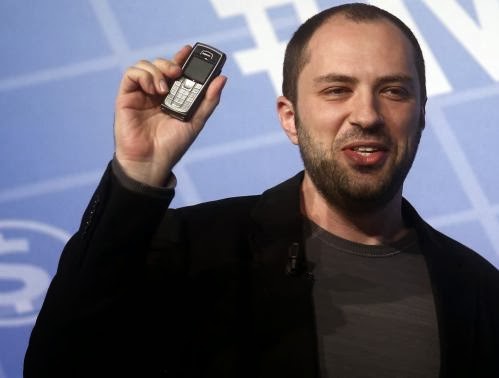
The text-based messaging service aims to let users make calls by the second quarter, expanding its appeal to help it hit a billion users, WhatsApp CEO Jan Koum said at the Mobile World Congress in Barcelona on Monday.

Buying WhatsApp has cemented Facebook's involvement in messaging, which for many people is their earliest experience with the mobile Internet. Adding voice services moves the social network into another core function on a smartphone.

On Monday, Chief Executive Mark Zuckerberg defended the price paid for a messaging service with negligible revenue. He argued that rival services such as South Korea's KakaoTalk and Naver's LINE are already "monetizing" at a rate of $2 to $3 in revenue per user per year, despite being in the early stages of growth.

Media reports put WhatsApp's revenue at about $20 million in 2013.

"I actually think that by itself it's worth more than 19 billion," Zuckerberg told the Mobile World Congress. "Even just independently, I think it's a good bet."

"By being a part of Facebook, it makes it so they can focus for the next five years or so purely on adding more people."

WhatsApp's move into voice calls is unlikely to sit well with telecoms carriers.

WhatsApp and its rivals, like KakaoTalk, China's WeChat, and Viber, have won over telecom operators' customers in recent years by offering a free option to text messaging. Telecom providers globally generated revenue of about $120 billion from text messaging last year, according to market researcher Ovum.

Adding free calls threatens another telecom revenue source, which has been declining anyway as carriers' tweak tariffs to focus on mobile data instead of calls.

WITH, NOT AGAINST

Since the advent a decade ago of Skype's voice over Internet service, which Microsoft Corp has acquired, and the rise of Internet service providers like Google Inc, telecom bosses have gotten used to facing challengers whose services piggyback on their networks. But carriers complain that the rivals are not subject to the same national regulations.

Mats Granryd, the CEO of Swedish mobile operator Tele2, said he was happy to partner with the likes of WhatsApp because of the additional data traffic they generate. But he shared the concerns of other network operators that they must operate under strict national regulations that Internet companies are not subject to.

"They (Internet firms) need to be regulated a little bit more and we need to be regulated a little bit less," said Jo Lunder, who heads Russian mobile network operator VimpelCom.

Vodafone CEO Vittorio Colao said he did not understand how such an important acquisition as the Facebook-WhatsApp deal could go unchallenged at a time when European network operators were facing intense regulatory scrutiny.

"These types of deal are a clear indication that the world is changing and the regulations don't fit anymore," Colao said on the sidelines of the conference.

Both Facebook and WhatsApp CEOs have cast themselves as partners to telecoms network operators.

On Monday, Koum also announced a partnership with E-Plus, the German subsidiary of Dutch group KPN, under which it will launch a WhatsApp-branded mobile service in Germany.

The European Parliament is set to vote on Monday night on a package of proposed telecoms market reforms which among other provisions would restrict the ability of carriers to charge internet companies like Facebook to give them an enhanced service in handling their network traffic.

Source: Reuters

Flash News

Flash News